Holy Days
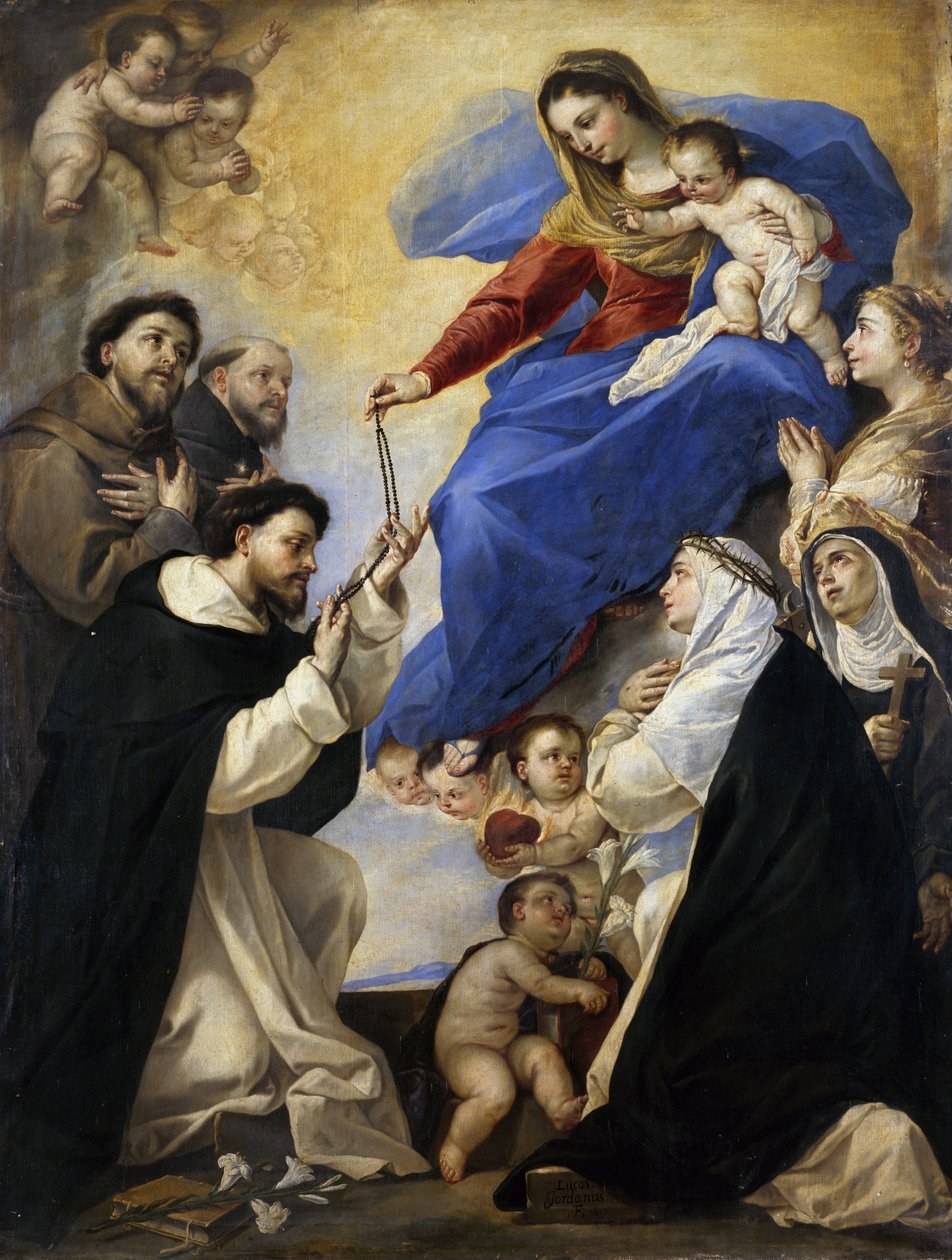
Our Lady of the Rosary
October 7, 1571: an outmatched fleet, a pope on his knees, and a continent with beads in its hands.
Listen above, or read her story right here — same story, your choice.
The Basics
- Feast day: October 7.
- The day remembers: the Battle of Lepanto, October 7, 1571, and the answer Heaven gave to a continent praying the Rosary.
- First celebrated: in 1571 by Pope St. Pius V, as “Our Lady of Victory.”
- Renamed: “Feast of the Holy Rosary” by Gregory XIII in 1573.
- For the whole Church: since 1716, under Clement XI.
- The month: October is the month of the Holy Rosary, spread worldwide by Leo XIII — remembered as “the Rosary Pope.”
What are we actually holding?
A rosary is a humble thing: a loop of beads, a crucifix, five sets of ten small beads divided by larger ones. You pray your way around it — an Our Father, then ten Hail Marys while you picture a scene from the life of Jesus and His mother, fifty Hail Marys in a full circuit, and the Joyful, Luminous, Sorrowful, and Glorious mysteries to dwell on. The beads keep count so the mind is free to wander through the Gospel. It is a prayer you can say in a chapel, in a car, or at a kitchen sink, and it asks nothing of you but your fingers and your attention.
Where did it come from? The Dominicans have always said their founder received it: tradition tells of Saint Dominic, discouraged after years of preaching with little fruit, being given the Rosary by Our Lady herself as the tool that would finally bear fruit. Whatever its exact early steps, the prayer spread through the Dominican order and the rosary confraternities that sprang up in towns across Europe. And in 1569 the Dominican pope, Saint Pius V, gave the Rosary the shape we still pray today. Two years later, it went to war — not with swords, but from the hands of ordinary people at home.
The year the map almost changed
In 1571 the Ottoman Empire was pressing westward and seemed unstoppable. Cyprus had just fallen. The next blow, everyone feared, would land on Italy itself and then roll through Europe. Pope Pius V spent his energy building something unlikely: a Holy League — Spain, Venice, Genoa, and the Papal States, nations that had spent decades quarreling with one another — persuaded to sail under one flag.
The man who led them was twenty-four years old: Don John of Austria, young, devout, and outmatched. The Ottoman fleet was larger, and its galleys were rowed in part by some twelve thousand Christian slaves chained to the oars. On paper, the League should have lost.
Pius V knew exactly how outmatched they were, so he fought the battle the way he knew how. He called on all of Europe to pray the Rosary for the fleet. Confraternities took to the streets and chapels of Rome in procession. In town after town, people who would never see the sea picked up their beads for sailors they would never meet. Then, on October 7, 1571, the two fleets met near Lepanto, in the Gulf of Patras.
The battle was brutal and, by every account, turned on the day itself: the wind the Christian ships needed came to them, and by evening the Ottoman fleet was destroyed. The twelve thousand Christian slaves were freed from the galleys. And in Rome, hundreds of miles away, tradition holds that Pius V rose in the middle of a meeting, went to a window, and announced that the fleet had won — days before any messenger could have arrived. Then he went to give thanks.
A thank-you that became a feast
Some victories get a parade. This one got a feast day. Pius V ordered an annual celebration in honor of “Our Lady of Victory,” because he was certain who had answered all those beads. His successor, Gregory XIII, gave it the name it keeps: in 1573 it became the Feast of the Holy Rosary, kept at first in churches with an altar to Our Lady of the Rosary on the first Sunday of October.
The feast kept growing the way the prayer did. Clement X extended it to Spain in 1671. And in 1716 — after Prince Eugene's victory at Peterwardein, won while the rosary confraternities of Rome were again praying for the armies — Clement XI gave the feast to the whole Church. In 1913, Saint Pius X fixed it where it has stayed: October 7, the very date of Lepanto.
The Rosary Pope
One more pope belongs in this story. Leo XIII loved the Rosary the way some people love a hometown. Across his long pontificate he wrote encyclical after encyclical urging the whole Church back to the beads — eleven or more by the usual count, beginning with Supremi Apostolatus Officio in 1883 — and he made October the month of the Rosary, asking that it be prayed publicly through the month. He also slipped a new title for Mary into the Litany of Loreto: “Queen of the Most Holy Rosary, pray for us.” History simply calls him the Rosary Pope.
And in 1917, at Fatima, when the children asked the beautiful Lady who she was, she answered with this feast's own words: “I am the Lady of the Rosary.” Then she asked what she has asked every century since: pray it every day.
Our Lady of the Rosary, pray for us.