
Saint Francis of Assisi
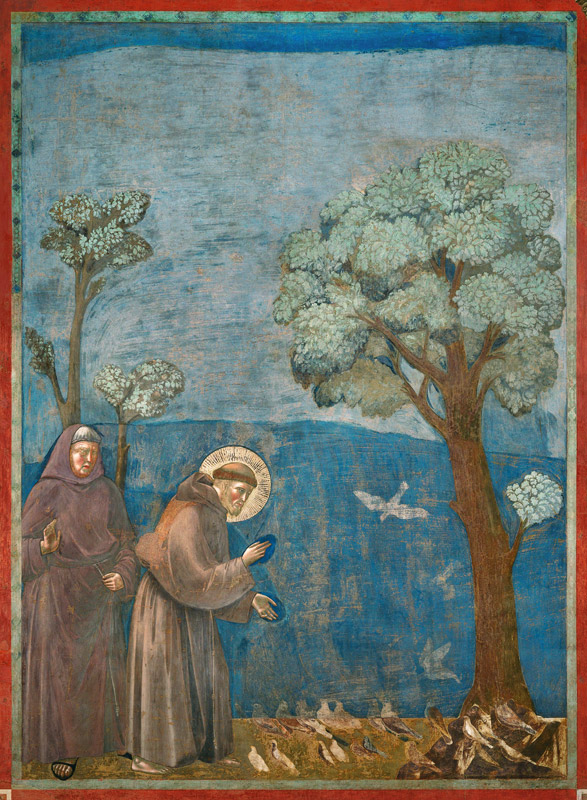
Tonight is his night. At sundown on October 3, all over the world, Franciscans gather quietly to mark the hour Francis of Assisi died. They call it the Transitus — the passing over. It is not a sad ceremony. It is a thank-you.
Francis died on October 3, 1226. His feast day is October 4, because in the old way of counting, a new day began at sundown. So the celebration of Saint Francis actually starts tonight, in the dark, which fits him. He was always comfortable in the dark, singing.
The Basics
Born: 1182, in Assisi, Italy — christened Giovanni, called Francesco (“the Frenchman”) because his father loved France and traded there.
Died: October 3, 1226, at the Portiuncula, the little chapel below Assisi. He was forty-four.
Feast day: October 4.
Patron of: animals, all of creation, and Italy.
Founded: the Franciscans (the Friars Minor); with Saint Clare, the Poor Clares; and the Third Order, for ordinary people who live at home and work in the world.
Known for: joy in having nothing; preaching to the birds; the first live Christmas crib; and the Canticle of the Creatures — Brother Sun, Sister Moon.
Here is the part most people miss. Francis did not start out holy. He started out rich.
His father, Pietro Bernardone, sold fine cloth all over Europe, and Francis grew up in silk. He was the best-dressed young man in Assisi, the loudest at the table, the one who paid for the wine. He sang louder than anybody — French songs, mostly, from his father's years of trading there — and what he wanted out of life was a sword, a horse, and a famous name. At twenty he rode off to war against the neighboring city of Perugia, in armor his father had paid for.
He came home a year later, ransomed out of a prison cell, sick in body and strange in his own skin. The parties bored him now. The clothes felt like a costume. He kept slipping away to be alone, to think, to pray in broken-down country chapels. His friends laughed and asked if he was in love. Francis said yes. He said he had chosen a bride more beautiful than anyone they had ever seen. He called her Lady Poverty.
✦ ✦ ✦
One day he was praying in San Damiano, a ruined little church outside the walls, before a painted crucifix that was falling apart along with the building. And he heard a voice. Francis, it said. Go and repair my house, which, as you can see, is falling down.
Francis took it literally. He loaded his horse with his father's best cloth, sold the lot in the next town, and carried the money to the priest at San Damiano. His father was a merchant. You can imagine the conversation when he got home.
It ended in church court, in the square, in front of the bishop. Pietro demanded his money and his son back. Francis stood up, stripped off every stitch of the fine clothes his father had given him, laid them at his father's feet with the money on top, and said that from now on he would say “Our Father who art in heaven” — and mean a different father. The bishop, to his credit, did not lecture anybody. He took off his own cloak and wrapped it around the naked young man, and Francis walked out of the square wearing it, singing.
He was not quite alone in it, though. On the road outside town he met a leper. Lepers were the people Francis had feared and hated most in his rich life — he used to hold his nose riding past their colony. This time he got down off the road, put money in the man's hand, and kissed it. Then he rode on, and when he looked back, he said later, the road was empty, and everything bitter had turned sweet. That kiss is the real beginning of everything that followed. Before Francis could love God in the sky, he had to love the person he had been walking around.
✦ ✦ ✦
He rebuilt San Damiano with his hands, stone by stone, and the Portiuncula, a tiny abandoned chapel in the woods that became the home he always came back to. And then men started to follow him. A wealthy lawyer named Bernard gave away everything he owned in one afternoon in the square, copying him. Within ten years there were five thousand friars. A teenage girl named Clare ran away from home on Palm Sunday night, cut her hair, and started the women's order. Ordinary married people asked how they could live this way without leaving their families, so Francis wrote a rule for them too. It may be the most sensible thing he ever did. He knew most of us are called to be holy at a kitchen table.
The friars owned nothing — no money, no houses, no spare cloak. They worked with their hands, begged when work failed, slept where they were given a floor, and sang on the roads in French. People who had only ever seen grim religion did not know what to make of them. Francis was building the Church again the way the voice had asked — not with stone this time. With people.
The famous tales come from these years, and they are worth telling the way they've always been told, as stories. When the brothers were walking between towns and Francis saw a flock of birds in a field, he stopped and preached to them — my little sisters, he said, you ought to praise your Creator — and the story says the birds stayed, and listened, and only flew when he blessed them and gave them leave. When a wolf was terrorizing the town of Gubbio, Francis walked out alone, called him Brother Wolf, and made a bargain: the wolf would stop killing, and the town would feed him for the rest of his life. The story says the wolf put his paw in Francis's hand like a handshake, and kept the bargain, and was mourned by the whole town when he died. True in every detail? We have them from the Little Flowers, the beloved book of tales gathered after his death. True in the way that matters? People who knew him say yes — this is exactly what he was like with every living thing.
On Christmas night in 1223, in the little town of Greccio, Francis did something nobody had ever done. He had a manger built in a cave, brought in an ox and a donkey, and celebrated Mass over the hay, because he wanted people to see Christmas with their own eyes — not a painting of Bethlehem, but the cold, the straw, the animal smell of it. Every live Nativity scene, every crèche on every sideboard, starts in that cave.
And in the middle of a holy war, he did the bravest thing of all. He crossed the battle lines in Egypt and walked unarmed into the camp of the Sultan, Malik al-Kamil, expecting to be killed, hoping at least to talk about peace and about Jesus. The Sultan listened to him for days, refused to convert, and sent him back under guard with respect — two men who should have been enemies, parting almost as friends. Francis came home with his eyes damaged by the Egyptian sun and sickness, and started, slowly, to go blind.
✦ ✦ ✦
In the autumn of 1224, on a mountain called La Verna, Francis received the wounds of Christ in his own hands, feet, and side — the first person in Christian history known to bear them. He kept them hidden under his habit for the last two years of his life, in pain, half blind, carried from town to town on a donkey because he could no longer walk.
And it was then, sick and in the dark, that he wrote the song he is loved for. The Canticle of the Creatures. Brother Sun, who brings the day. Sister Moon and the stars. Brother Wind, Sister Water — humble and precious and pure. Sister Fire. Mother Earth. He wrote it as a man going blind, praising a world he could barely see anymore. Near the very end he added a verse welcoming even Sister Death — not because he was morbid, but because by then death was just one more member of the family he had spent his life loving.
At the end he asked to be carried back to the Portiuncula, to his little chapel in the woods. He asked to be laid naked on the bare earth, the way he had walked out of his father's house twenty years before, owning nothing. He sang Psalm 142 — I cry aloud to the Lord; I lift up my voice — and the brothers around him wept, and Francis died singing, on the evening of October 3, 1226. The brothers swore that larks, birds that belong to the daylight, came down out of the dark and circled the roof, singing. He was forty-four years old. In less than two years the Church named him a saint, which for that century was the speed of lightning.
One last thing, because you will hear it this week and it is a good story in itself. The prayer everybody calls the Prayer of Saint Francis — “Lord, make me an instrument of your peace” — was not written by Francis. Nobody had ever seen it before December 1912, when it turned up, unsigned, in a little French magazine. The world pinned it on Francis anyway, because it sounds so much like him that it might as well be his. Where there is hatred, let me sow love. He never wrote that sentence. He just spent forty-four years living it, which is better.
If you want to mark his night the way he would have liked, it is simple. Step outside tonight. Look at the sky. Thank God out loud for one ordinary thing — the moon, the wind, hot water, the dog. Francis would have called every one of them brother or sister, and he would have been right.